Paper thread · Long-context sequence modeling ·
Proteus
Incremental Memory Activation for Long-Context Sequence Modeling
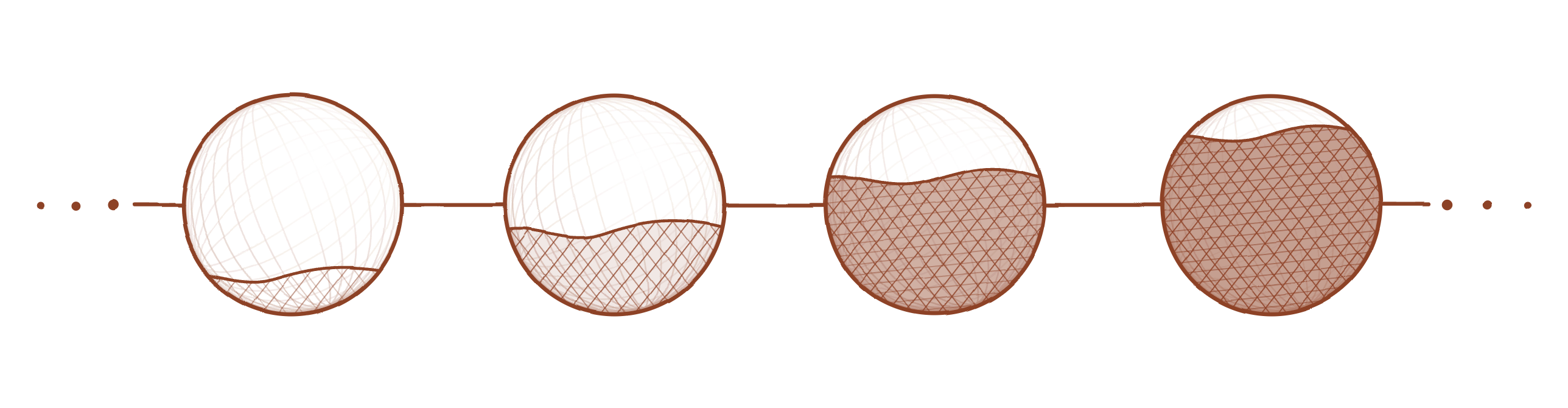
TL;DR. Most memory models expose their full state from the very first token, so early context spreads across it unchecked and later context can only overwrite what is already there. Proteus schedules that capacity instead: one block is active at first, and more unlock as the context grows. It is a drop-in gate that adds no parameters and no compute, and it improves four state-of-the-art architectures — with the largest gains at the longest contexts.
We introduce incremental memory activation: a fixed-size memory should not expose all of its capacity at once. It should schedule how much is live as the context grows, imposing a bottleneck early that forces the model to summarize rather than memorize, and unlocking fresh capacity later so new information has somewhere to land that isn't already written.
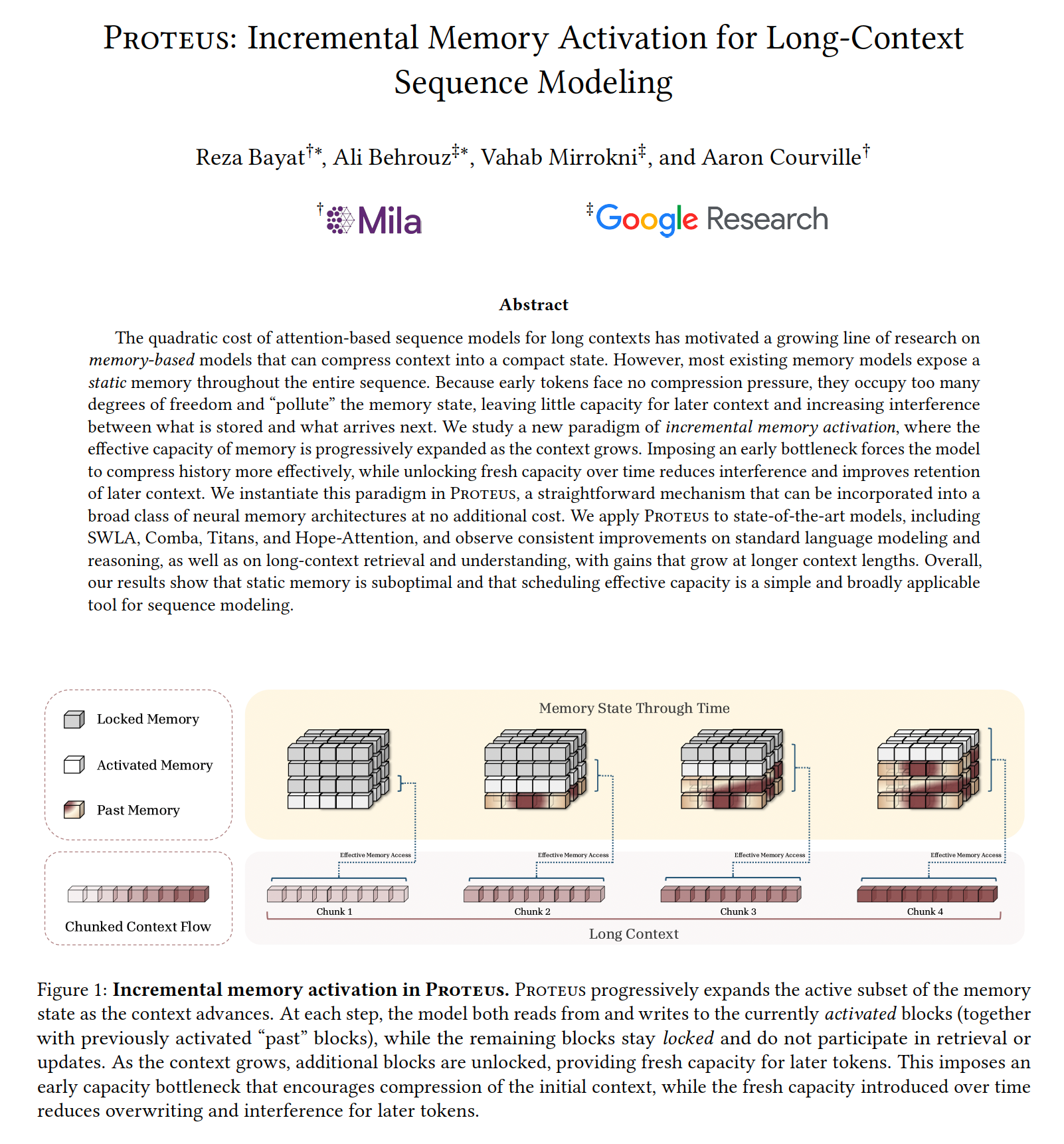
Proteus is the simplest instantiation of that idea. We partition the memory into E blocks and unlock them one at a time as the context advances, gating both reads and writes so locked blocks are neither retrieved from nor updated. The state itself never grows; only the active fraction of it changes. It comes at no extra cost and improves average performance on language modeling and commonsense reasoning (+0.37–1.05 avg. accuracy points). More interestingly, it yields significant gains in long-context handling: up to +8.4 NIAH points at 2× the training context length.
Read more background/method/results below 🧵
Transformers store every token: perfect memory, but quadratic cost.
Recurrent memory models fix this: they compress context into a fixed-size state that updates as tokens flow in.
Think of it as a notebook with limited pages. You have to decide what's worth writing down.
Early tokens spread freely across all pages with no compression pressure. By the time later tokens arrive, the notebook is already full of early drafts. Every new line has to be squeezed in, and each one smudges what's already on the page.
This is static memory, and it's the default across the whole family.
We partition memory into E blocks and lock all but the first. Every N/E tokens, one more block unlocks, on a fixed deterministic schedule (E = 16 by default).
Both reads and writes are gated: locked blocks are neither retrieved from nor updated, and keep exactly the values they held.
Note what we're not doing: the memory never grows. Same fixed-size state, same compute. We only schedule which part of it is live.
🔹 Early bottleneck → few active blocks means early tokens must summarize, not memorize
🔹 Fresh capacity → later tokens get fresh room to land in, so less of what's stored gets overwritten
Activation is monotone: nothing is ever discarded, and the whole memory is live by the end of the schedule.
That's why one gate drops into four very different models: Hope-Attention, SWLA, Comba, and Titans.
Setup: 760M and 1.3B params, trained on 50B and 100B FineWeb tokens with an 8K context window.
On the hardest single-needle variant (S-NIAH-3, UUID retrieval), Proteus is roughly neutral at 4K, then opens a large gap at 16K. Titans goes 21.4 → 29.8, Hope-Attention 50.0 → 54.4. Comba picks up +7.8 on numeric needles at the same length (13.4 → 21.2).
The multi-needle settings tell the same story. At 16K, Proteus improves all three backbones on multi-key, multi-query and multi-value retrieval alike.
We train at 8K, and the schedule finishes inside that window. At 16K, no extra blocks unlock. The memory has been fully active for a while.
The gain isn't extra capacity. It's that a state compressed under an early bottleneck degrades more gracefully past the training length.
No. Measuring validation perplexity by token position, Proteus is lower at every one of them. The gap peaks at 6K, then stays open at roughly 0.3 ppl all the way out to 32K — far past the training window. By 8K, the memory is fully active.
E = 1 is the base model. Perplexity improves through E = 16, then gets worse at E = 32. Squeeze the first tokens into 1/32 of the memory and the bottleneck costs more than the compression buys.
Note: through the Nested Learning view, MLP blocks are themselves associative memory — so the same principle applies to a model's parameters, activated progressively over training rather than over context. We show a proof of concept on Hope-Attention's MLP blocks.
Recap. Static capacity is the default. We think it shouldn't be. Scheduling it is simple, costs nothing, and helps across architectures.
📄 Paper: arxiv.org/pdf/2608.16844
Citation
If you found this thread useful and would like to cite the paper:
Plain text
Bayat, Reza, Ali Behrouz, Vahab Mirrokni, and Aaron Courville. “Proteus: Incremental Memory Activation for Long-Context Sequence Modeling.” arXiv preprint arXiv:2608.16844 (2026).
BibTeX
@article{bayat2026proteus,
  title   = {{Proteus: Incremental Memory Activation for Long-Context Sequence Modeling}},
  author  = {Bayat, Reza and Behrouz, Ali and Mirrokni, Vahab and Courville, Aaron},
  journal = {arXiv preprint arXiv:2608.16844},
  year    = {2026}
}